
 admin
adminVideo credit: Campers Inn RV
How much is my RV worth? It sounds like a simple question. Then you start searching online and discover three different prices for the same RV, four different “Blue Book” websites, a dealer offering you much less than you expected, and suddenly your beloved camper appears to have developed an identity crisis.
Don’t worry. RV valuation really is more complicated than car valuation, but you can get a very useful estimate if you know where to look.
The biggest update for 2026 is this: there is no current official Kelley Blue Book RV valuation tool. For RVs, one of the main industry reference points is the J.D. Power RV pricing and valuation system, which many RV owners still casually call the NADA RV Guide or NADA RV Blue Book. J.D. Power’s current RV section covers motorhomes, travel trailers/fifth wheels, camping trailers, truck campers and park models.
But here’s the secret experienced RV buyers and sellers understand: the book value is a starting point, not a magic number.
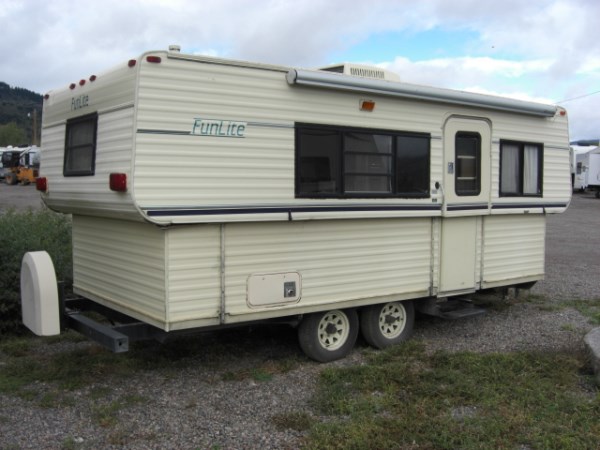
Is There an RV Blue Book in 2026?
If you searched Google for “RV Blue Book,” you’re certainly not alone. It is one of the most common phrases people use when trying to price a motorhome, travel trailer, fifth wheel or camper.
However, the terminology can be confusing.
Kelley Blue Book does not currently provide an official RV valuation tool comparable to its car pricing tools. For RVs, J.D. Power is the major online reference point descended from the old NADA Guides system. That’s why you’ll often see the phrases NADA RV values, NADA RV Guide and J.D. Power RV values used almost interchangeably.
The J.D. Power RV section currently lets shoppers research pricing and specifications across several RV categories.
So if someone tells you, “Just check the RV Blue Book,” what they usually mean is: start with J.D. Power/NADA RV values and then compare that number with the real market.
What Happened to the NADA RV Guide?
Older AutoCarHub articles referred readers directly to NADA Guides for RV pricing. That made sense at the time.
In fact, AutoCarHub’s earlier guide explained how readers could choose an RV manufacturer, select the model year and body style, and then view suggested list, low retail and average retail pricing.
The important thing for today’s buyer is that the online experience has changed.
J.D. Power now hosts the RV pricing system. The current J.D. Power RV page describes its service as a way to research used RV pricing, specifications, photos and more.
So don’t panic if you type “NADA RV Guide” into Google and end up somewhere that says J.D. Power.
You’re looking in the right neighborhood.
How to Find Your RV Value Using J.D. Power / NADA
The process is fairly straightforward once you have the correct information about your RV.
Step 1: Identify Your Exact RV
Before entering anything into a valuation tool, collect the exact details.
- Model year
- Manufacturer
- Model name
- Model number or trim
- Floor plan
- RV type
- Length
- Engine and chassis, if applicable
- Mileage for motorhomes
- Major factory options
- Major upgrades
This sounds boring.
It is also where a surprising number of RV valuations go wrong.
Choosing a similar-looking model instead of the exact model can produce a number that has very little to do with your actual RV.
Step 2: Choose the Correct RV Category
J.D. Power separates RVs into categories such as motorhomes, travel trailers/fifth wheels, camping trailers, truck campers and park models.
Choose carefully.
A Class A motorhome is not a Class C. A fifth wheel is not a conventional travel trailer. A truck camper isn’t simply a tiny travel trailer with a different name.
Even when two RVs look similar in photographs, their valuation can be completely different.
Step 3: Select the Manufacturer and Model
Next, select the correct manufacturer and model.
J.D. Power maintains a large database of RV manufacturers, including brands such as Airstream, Coachmen, Forest River, Grand Design, Jayco, Keystone, Thor Motor Coach, Winnebago and many others.
This is particularly useful when you’re researching an older RV because the database includes many historical makes and models.
Step 4: Add the Correct Equipment and Options
This is where you need to slow down.
RVs can be packed with options.
Solar systems, generators, upgraded air conditioners, premium appliances, entertainment systems, suspension upgrades, slide-outs and other equipment can affect what buyers are willing to pay.
Don’t assume that every dollar you spent on an upgrade will come back to you dollar-for-dollar, though.
That $4,000 custom entertainment system may be worth $4,000 to you. A buyer might look at it and think, “Nice,” then offer you an extra $500.
Welcome to resale economics.
What Do NADA RV Values Actually Mean?
One of the most confusing parts of RV valuation is understanding the numbers once you get them.
J.D. Power RV valuation pages can show different pricing references depending on the specific RV and model year. For example, current J.D. Power valuation pages can display suggested list price, base price, low retail value and average retail value.
Suggested List Price
This is generally associated with the manufacturer’s suggested pricing or original list-price concept.
It should not automatically be treated as today’s realistic used-RV selling price.
If someone tells you, “This RV originally had an MSRP of $120,000, so I’m asking $95,000,” that doesn’t automatically make $95,000 a bargain.
The RV may have depreciated. The market may have changed. Newer versions may be cheaper. Demand may have fallen.
The original sticker is history, not today’s market.
Low Retail Value
Low retail provides another reference point for the value of a used RV.
It can be useful when you’re thinking about trade-in negotiations, but it should not be treated as a guaranteed dealer offer.
A dealer still has to inspect your RV, account for reconditioning, consider demand and decide whether the unit makes financial sense for its inventory.
Average Retail Value
Average retail can provide a useful reference for what a dealer might expect when selling a comparable RV in an appropriate market.
But again, don’t confuse a published value with a guaranteed selling price.
The actual number can move significantly based on condition, options, location, timing and buyer demand.
How Much Is My RV Really Worth?
This is the question everyone actually wants answered.
The best answer is: your RV is worth a range, not a single number.
Think about three different buyers:
- Dealer: wants enough margin to inspect, recondition, advertise and resell the RV.
- Private buyer: may pay more because there is no dealer middleman.
- Wholesale buyer: may pay less because the unit has to be resold and the buyer assumes additional risk.
All three can produce completely different numbers for the exact same RV.
And all three numbers can be legitimate.
RV Trade-In Value vs. Private-Sale Value
This is where many RV owners get frustrated.
You research your RV and see listings around $70,000. Then you walk into a dealership and they offer $52,000.
“What happened to my $70,000 RV?”
Nothing happened.
You simply asked two different markets to price it.
A dealer has to think about transportation, inspection, repairs, advertising, sales costs, inventory time, financing and profit. A private buyer doesn’t have all of those expenses.
That’s why a private-party sale can potentially bring you more money, while a dealer trade-in can be quicker and easier.
The important thing is to compare apples with apples.
Use RV Trader to Check Real-World Prices
Book values are useful, but live marketplace data is extremely important.
RV Trader currently offers an RV valuation tool where owners can enter details such as year, make and model to receive an estimated market valuation. Its system also adjusts values to local market conditions, and RV Trader says the calculations are provided in collaboration with J.D. Power.
That’s useful because your RV isn’t being sold in “America.”
It’s being sold somewhere specific.
A travel trailer in Florida may attract a different buyer pool from one sitting in Minnesota. A Class B camper van may have a different demand profile from a giant fifth wheel.
Location matters.
Don’t Confuse Asking Price With Selling Price
This is one of the biggest mistakes people make when researching RV values.
You find ten similar RVs listed for $80,000 and assume your RV is worth $80,000.
Maybe.
But maybe those ten RVs have been sitting unsold for months.
An asking price tells you what the seller wants.
A completed transaction tells you what a buyer actually paid.
That distinction can save you thousands.
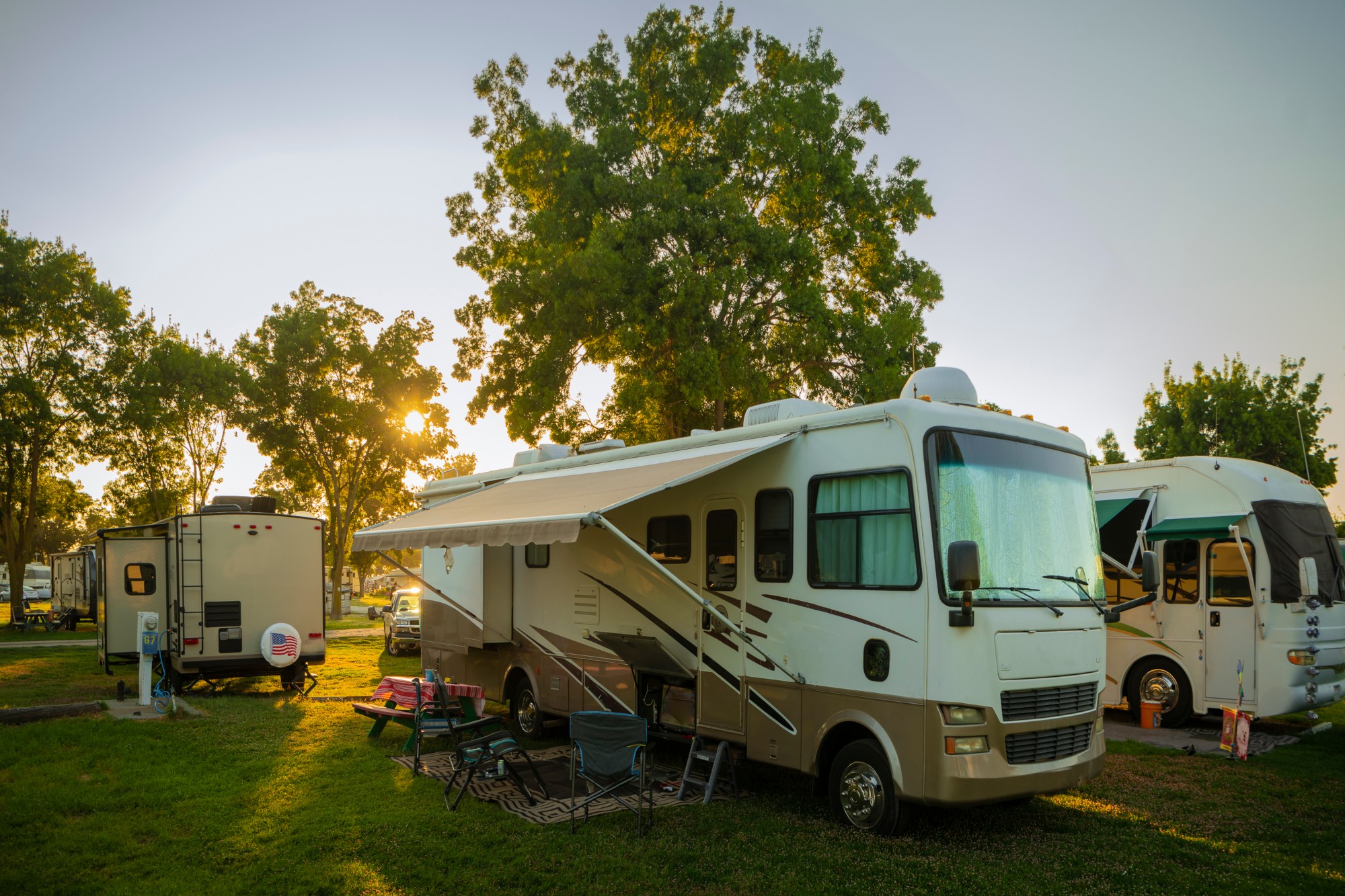
The 10 Biggest Factors That Affect RV Value
1. Age
Age matters, but it isn’t everything.
A beautifully maintained older RV can be more attractive to a buyer than a newer unit that has been neglected.
2. Brand Reputation
Some manufacturers and models have stronger demand than others.
Brand reputation can influence resale value, especially when buyers are comparing several similar RVs.
3. Condition
This is huge.
A clean, dry, well-maintained RV is easier to sell than one with stains, odors, broken appliances and mysterious soft spots.
And when it comes to RVs, water damage can be a value killer.
4. Mileage
For motorhomes, mileage matters because the RV has a drivetrain and engine that have accumulated use.
A low-mileage motorhome with strong maintenance records can be attractive.
But don’t obsess over mileage while ignoring maintenance.
A high-mileage motorhome that was serviced regularly may be a better buy than a low-mileage coach that sat unused for years.
5. Floor Plan
Floor plan can have a surprisingly large effect on demand.
Families may want bunk beds. Couples may prefer a spacious rear-bedroom layout. Full-time RVers may care more about workspace, storage and kitchen design.
The same manufacturer can produce two RVs in the same year that attract completely different buyers simply because the floor plans are different.
6. Optional Equipment
Solar, upgraded appliances, generators, slide-outs, premium HVAC systems and other equipment can improve desirability.
But don’t assume every upgrade increases value by its original purchase price.
7. Maintenance History
Documentation is powerful.
Receipts for oil changes, roof maintenance, tire replacements, appliance repairs and other work can reassure a buyer that the RV wasn’t simply polished five minutes before the listing went live.
8. Roof and Water Condition
If I were buying a used RV, I’d pay extremely close attention to the roof and signs of water intrusion.
Look for stains, soft spots, repaired areas, damaged sealant, bubbling materials and musty odors.
A beautiful interior cannot make a wet wall a good investment.
9. Location
Demand varies from region to region.
That means the same RV can command different prices in different markets.
10. Season
RV demand can be seasonal. Spring and summer are traditionally important shopping periods, while fall and winter can sometimes give buyers more negotiating leverage. Seasonal effects are only one factor, though, and local conditions can produce exceptions.
RV Depreciation: How Much Value Does an RV Lose?
RVs generally depreciate, but there is no single depreciation formula that works perfectly for every camper.
A luxury Class A, a compact Class B, a family travel trailer and a fifth wheel can all behave differently.
J.D. Power’s historical RV market reports demonstrate that RV values can move by category and by time period rather than following one universal curve.
That is why I would be cautious about articles promising something like “every RV loses exactly 20% in year one and 10% every year afterward.”
Real markets are messier.
Demand changes.
Fuel prices change.
Interest rates change.
New RV discounts change.
And buyers change their minds.
Does Mileage Matter More on a Motorhome?
Usually, mileage deserves more attention on a motorhome than on a towable trailer because the motorhome has an engine, transmission and chassis accumulating road use.
But mileage should always be viewed together with maintenance.
Imagine two motorhomes:
- Motorhome A has 30,000 miles and almost no maintenance records.
- Motorhome B has 50,000 miles but has complete service records, recent tires and documented repairs.
Which one would you trust more?
For many buyers, the answer might be B.
That is why documentation can be worth real money.
Do RV Upgrades Increase Resale Value?
Sometimes.
This is one of the most misunderstood parts of RV pricing.
Suppose you spend $8,000 installing solar panels, batteries, an inverter and upgraded electrical equipment.
You might expect the RV’s value to increase by $8,000.
Unfortunately, the market doesn’t always work that way.
The right buyer may love your upgrades and pay a premium. Another buyer may prefer a stock RV and not care about your electrical system at all.
The safest approach is to treat upgrades as features that can improve desirability, not as guaranteed dollar-for-dollar investments.
What Upgrades Can Help an RV Sell Faster?
Useful upgrades are generally easier to explain than highly personal modifications.
- Solar and battery upgrades
- Modern inverter systems
- Newer tires
- Updated entertainment systems
- Modern appliances
- Improved lighting
- Fresh flooring
- Professional roof maintenance
- New awning fabric
- Documented mechanical maintenance
But remember: the goal isn’t to turn your RV into a rolling science experiment.
If you spend $20,000 improving a $30,000 RV before selling it, you may not recover the money.
Do the math first.
How to Increase Your RV’s Value Before Selling
You don’t necessarily need to spend thousands of dollars.
Sometimes the cheapest improvements are the most effective.
Deep Clean Everything
Clean the floors, cabinets, appliances, windows, bathroom, storage compartments and exterior.
Remove personal clutter.
Buyers need to imagine themselves inside the RV.
Fix Small Problems
Replace broken handles. Repair loose cabinet doors. Fix obvious leaks. Replace burned-out lights.
A long list of tiny problems can make a buyer wonder what bigger problems are hiding underneath.
Document Maintenance
Put receipts and service records together.
Create a simple maintenance folder.
It looks professional and makes the buyer’s job easier.
Photograph It Properly
Take photographs during daylight.
Open the blinds.
Turn on the lights.
Clean the counters.
Show the storage.
Photograph the roof, tires, generator, engine compartment and major appliances.
Good photographs can make the difference between someone clicking your listing and someone scrolling past it.

How to Price Your RV for a Private Sale
Here’s a simple strategy.
Start With the Book Value
Use J.D. Power/NADA as your baseline.
Find Five to Ten Comparable RVs
Try to match:
- Year
- Make
- Model
- Floor plan
- Length
- Mileage
- Condition
- Region
Remove the Crazy Listings
Ignore the seller asking $20,000 more than everyone else unless there is a clear reason.
Adjust for Condition
If your RV has new tires, a clean roof, excellent maintenance records and desirable upgrades, you may be able to price toward the stronger end of the range.
If it has water damage, old tires or broken appliances, price accordingly.
Leave Room for Negotiation
Private buyers often negotiate.
If your realistic target is $55,000, you might list slightly above that if the market supports it.
Don’t list at $75,000 just because you secretly want $55,000.
You’ll spend six months explaining to strangers why your RV is “worth every penny.”
How to Negotiate an RV Price
Whether you’re buying or selling, preparation beats confidence.
If you’re buying, don’t just say, “Can you do $50,000?”
Explain why.
“Comparable units are listed around $48,000 to $52,000, this one needs four tires, the awning needs repair, and the generator service is overdue. Based on those factors, I’m comfortable at $48,500.”
That is a much stronger negotiation.
You’re not throwing a random number at the seller.
You’re building a case.
RV Blue Book Value vs. Actual Market Value
| Value Source | Best Used For | Important Limitation |
|---|---|---|
| J.D. Power / NADA | Starting benchmark | Does not replace an inspection or live market research |
| RV Trader | Current market comparison | Listings may show asking prices rather than completed sales |
| Dealer appraisal | Trade-in or quick-sale estimate | Dealer must leave room for resale costs and profit |
| Private-party listings | Understanding seller expectations | Asking prices are not guaranteed transaction prices |
| Professional appraisal | High-value, unusual or disputed RVs | Usually costs more than an online estimate |
Can You Use Kelley Blue Book for an RV?
This question deserves a direct answer.
Don’t assume the current Kelley Blue Book car valuation tool will give you an official RV value.
For RVs, J.D. Power/NADA is the more relevant established valuation reference. RV Trader also provides a current RV valuation service and says its calculations are made in collaboration with J.D. Power.
AutoCarHub has several other articles about vehicle valuation, including our guides to Kelley Blue Book used-car values and Edmunds True Market Value.
Why RV Book Values Are Not Perfect
An online valuation tool can’t physically inspect your RV.
It can’t smell the musty carpet.
It can’t press its foot against a soft floor.
It can’t look at the roof and notice a questionable repair.
It can’t determine whether the previous owner lovingly maintained the generator or simply hoped it would survive another season.
That is why a book value is a benchmark.
Your actual RV value is influenced by its physical condition and the market around you.
RV Value for Insurance: Why It Matters
Knowing an approximate RV value can also help when thinking about insurance.
You don’t want to discover after a major loss that you had a misunderstanding about how your policy determines the vehicle’s value.
Insurance policies can use different valuation approaches, so read your policy carefully and speak with your insurer about whether the coverage is based on actual cash value, agreed value, replacement cost or another method.
Don’t assume a J.D. Power/NADA number automatically equals the amount an insurer will pay.
RV Value for Financing
RV valuation can also matter when financing a purchase.
Lenders may use their own underwriting rules and valuation sources when deciding how much they’re willing to finance.
That’s another reason not to walk into a dealership saying, “I don’t care what it costs because the payment is only $700.”
Look at the total price.
Look at the interest rate.
Look at the loan term.
And look at the amount you are financing.
Common RV Valuation Mistakes
Mistake #1: Using the Wrong Model
Small differences in floor plan, trim or equipment can matter.
Mistake #2: Using the Original MSRP
The original sticker price doesn’t tell you today’s market value.
Mistake #3: Looking at Only One Website
One number is not enough.
Mistake #4: Confusing Asking Price With Selling Price
Just because somebody asks $90,000 doesn’t mean anybody will pay $90,000.
Mistake #5: Ignoring Condition
A pristine RV and a neglected RV of the same year are not worth the same amount.
Mistake #6: Adding Every Upgrade to the Price
Buyers don’t necessarily reimburse you for your entire renovation budget.
Mistake #7: Forgetting Seasonality
Market demand can change throughout the year.
Mistake #8: Getting Emotionally Attached
Your RV may have carried your family across the country, survived a dozen campfires and witnessed the greatest sandwich you’ve ever eaten.
That’s wonderful.
But sentimental value and market value are two different things.
How Buyers Can Use RV Blue Book Values
If you’re buying an RV, use the valuation number as a negotiation tool.
Suppose the J.D. Power/NADA reference is $60,000 and comparable listings are around $58,000 to $65,000.
Then you inspect the RV and discover:
- Four old tires
- A damaged awning
- Two appliances that need service
- Cosmetic exterior damage
- No maintenance records
You now have a much stronger reason to negotiate below the top of the range.
The book didn’t negotiate for you.
Your research did.
How Sellers Can Use RV Blue Book Values
If you’re selling, don’t simply copy the highest valuation number and put it in your listing.
Instead, build a range.
For example:
| Reference | Example |
|---|---|
| J.D. Power/NADA benchmark | $48,000 |
| Comparable private listings | $50,000–$55,000 |
| Dealer asking prices | $56,000–$60,000 |
| Your RV’s condition | Above average |
| Potential private-sale target | $54,000–$56,000 |
The numbers above are only an illustration, not a valuation of a specific RV.
The point is to combine several sources instead of blindly trusting one number.
Should You Sell Privately or Trade In?
There is no universal winner.
Sell privately if your priority is maximizing the sale price and you are willing to handle messages, showings, negotiation and paperwork.
Trade in if your priority is convenience, speed and reducing the hassle of selling the RV yourself.
Before accepting a trade offer, compare it with your estimated private-sale value.
If the dealer offers $40,000 and you believe you could realistically sell privately for $50,000, you’re potentially giving up $10,000 in exchange for convenience.
Maybe that’s worth it.
Maybe it isn’t.
At least you’ll know what you’re trading away.
How to Get the Most Money for Your RV
- Clean it thoroughly.
- Repair obvious small problems.
- Maintain the roof and seals.
- Replace dangerously old tires.
- Organize maintenance records.
- Photograph the RV professionally.
- Be honest about defects.
- Research comparable listings.
- Use J.D. Power/NADA as a baseline.
- Check RV Trader’s valuation tools.
- Choose a realistic asking price.
- Be prepared to negotiate.
- Sell when demand is favorable if timing is flexible.
For more vehicle-pricing information, you can also explore AutoCarHub’s Price Guide section.
More AutoCarHub Vehicle Valuation Guides
If you’re researching RV values because you’re also comparing other vehicle prices, these AutoCarHub resources may be useful:
- NADA Guide RV: How to Find the Value of Your RV
- Kelley Blue Book Values for Used Cars
- Edmunds True Market Value Guide
- Edmunds Car Value Guide
- Kelley Blue Book for Motorcycles
- Common KBB Motorcycle Valuation Mistakes
- Kelley Blue Book for Classic Cars
- Edmunds Car Values vs. Other Pricing Guides
- AutoCarHub Price Guide
- AutoCarHub Motorcycle Guides
- Kelley Blue Book for Snowmobile Values
- Kelley Blue Book Boat Value Guide
Frequently Asked Questions About RV Blue Book Values
Is there a Kelley Blue Book for RVs?
There is no current official Kelley Blue Book RV valuation tool comparable to its car valuation tools. For RVs, J.D. Power’s RV pricing system is the major established reference and is commonly associated with the old NADA RV Guides.
What is the NADA RV Blue Book?
“NADA RV Blue Book” is a common term people use for RV valuation information historically associated with NADA Guides. Today, the RV valuation tools are hosted by J.D. Power.
How do I find my RV’s value?
Start with J.D. Power’s RV valuation tools, then compare your RV with current listings on RV Trader and other marketplaces. Adjust for condition, mileage, floor plan, upgrades, location and season.
Is J.D. Power RV value accurate?
It can be a useful benchmark, but it should not be treated as a guaranteed sale price. Your RV’s actual market value can differ because of condition, location, options, demand and the type of transaction.
Does mileage affect RV value?
Yes, particularly for motorhomes. However, mileage should be considered alongside maintenance history, mechanical condition and overall care.
Do RV upgrades increase value?
They can improve desirability, but they do not necessarily increase resale value by the full amount spent. Popular functional upgrades are generally easier for buyers to appreciate than highly personalized modifications.
Does RV condition affect value?
Absolutely. Roof condition, water intrusion, tires, appliances, interior wear, exterior condition and maintenance records can have a major effect on what buyers are willing to pay.
Is an RV dealer trade-in value lower than private-sale value?
It often is because the dealer needs room for inspection, reconditioning, inventory costs and resale profit. That doesn’t make the dealer offer “wrong”; it represents a different type of transaction.
Does the time of year affect RV prices?
Seasonality can influence RV demand and pricing. Spring and summer are often stronger shopping periods, while fall and winter can sometimes provide better opportunities for buyers, although local market conditions vary.
Should I get a professional RV appraisal?
For an ordinary RV sale, a combination of book values and comparable listings may be enough to establish a useful range. A professional appraisal can make more sense for an unusually valuable RV, estate situation, insurance matter, legal dispute or highly customized unit.
The Bottom Line: How to Find the True Worth of Your RV
The phrase RV Blue Book value makes it sound as though there is one magical number hiding somewhere online.
There isn’t.
The smarter approach is to build your own valuation using several pieces of evidence.
Start with J.D. Power/NADA RV values.
Then check RV Trader and comparable listings.
Look closely at your RV’s condition.
Consider mileage, floor plan, brand, options, maintenance records, location and season.
Finally, decide whether you’re looking for the value of a quick dealer trade, a private-party sale or the retail price a dealer might ask.
Those are different numbers.
And once you understand that, RV pricing becomes much less mysterious.
The most important rule is simple: don’t let one website tell you what your RV is worth without checking the real market.
Your RV isn’t just a year, make and model in a database.
It’s a specific machine, in a specific condition, in a specific location, being sold at a specific moment.
That’s why the best RV valuation isn’t a single number.
It’s a well-researched price range that you can defend when the negotiation begins.
Official RV Valuation Resources
Check current J.D. Power RV prices and values.
Check RV Trader’s current RV valuation tool.
Visit the U.S. Consumer Product Safety Commission for consumer safety information.


Add comment